
QLD Smoke Alarm Legislation — Everything You Need to Know
Queensland’s smoke alarm laws are changing how every Brisbane home is protected. Whether you own, rent, sell or manage property, the rules now demand photoelectric, interconnected alarms throughout every dwelling. Here is the complete breakdown of what the law requires, who it affects, and what happens if you do not act before the deadline.
Time Remaining Until the 2027 Owner-Occupier Deadline
Every Brisbane homeowner who has not yet upgraded will need compliant smoke alarms installed before this clock reaches zero.
How QLD smoke alarm legislation has rolled out since 2017
Queensland did not introduce these requirements overnight. The legislation has been phased in over a decade, starting with new builds and progressively capturing every residential property in Brisbane and across the state.
The Fire and Emergency Services (Domestic Smoke Alarms) Amendment Act 2016 took effect. From this date, any new dwelling or property undergoing substantial renovation in Queensland was required to meet the upgraded standard: photoelectric alarms, interconnected, installed in every bedroom, in hallways connecting bedrooms, and on every level. Brisbane builders and developers had to factor this into every new project from day one.
The second phase brought existing dwellings into scope whenever they were leased, sold or transferred. For Brisbane landlords, this meant full compliance was required at the point of new lease or lease renewal. For sellers, compliance became a condition of the property transfer. This phase caught many Brisbane property owners off guard, particularly those managing older rental stock with outdated ionisation alarms or missing bedroom coverage.
The final phase captures every remaining residential property in Queensland, including owner-occupied homes that have not been sold, leased or substantially renovated since 2017. This is the group facing the most immediate pressure in Brisbane right now. If you live in your own home and have not upgraded your smoke alarms to the new standard, this is your deadline. There are no further extensions planned.
What does a compliant smoke alarm system look like in Brisbane?
The legislation is specific about the type of alarm, how they connect to each other, where they go, and what standards they must meet. Here is what the law actually requires inside a Brisbane dwelling.
Technical requirements under QLD law
- Photoelectric sensing technology only — ionisation alarms are no longer acceptable under Queensland legislation, even if they are still functional
- All alarms must be interconnected so that when one detects smoke, every alarm in the dwelling sounds simultaneously — hardwired or wireless RF interconnection both satisfy this
- Installed in every bedroom, in hallways that connect bedrooms to the rest of the dwelling, and on every storey — including levels without bedrooms
- Must comply with Australian Standard AS 3786:2014 — older alarms manufactured to earlier standards do not meet the current requirement
- Powered by either 240V hardwired connection with battery backup, or a sealed non-removable 10-year lithium battery — replaceable 9V batteries are no longer compliant
- Ceiling-mounted in accordance with manufacturer instructions — typically at least 300mm from walls, light fittings and air conditioning vents
Why these specific requirements matter
Photoelectric alarms respond faster to smouldering fires, which are the most common cause of fatal house fires in Australia. Ionisation alarms are better at detecting fast-flaming fires but are slower with the smouldering type that typically occurs at night when occupants are asleep.
Interconnection is critical because a single alarm in a hallway may not wake someone sleeping behind a closed bedroom door at the other end of a Brisbane home. When alarms are linked, the bedroom unit sounds at the same moment as the hallway unit, cutting response time dramatically.
The placement rules — bedrooms, hallways, every level — reflect research showing that fires can start anywhere in a dwelling and that sleeping occupants are the most vulnerable. A Brisbane home with alarms only in the hallway and kitchen is not meeting the current standard, regardless of how recently those alarms were installed.
The sealed 10-year battery requirement eliminates the problem of flat batteries. In older setups, occupants would remove 9V batteries to stop nuisance beeping and never replace them. Sealed units cannot be tampered with and last the full life of the alarm.
What’s changed at a glance
Every row below represents a requirement that has gotten stricter. If your home still matches the left column, you need to upgrade.
If any row on the left matches your current setup, your home is not yet compliant.

What the law is really trying to achieve for Brisbane families
Queensland smoke alarm legislation is not just a box-ticking exercise for Brisbane homes. It is designed around one simple problem: people often do not wake quickly enough in a night-time fire. That is why the legislation focuses on alarms in bedrooms, not just communal spaces, and why interconnection matters so much.
In a typical Brisbane family home, one child may be sleeping upstairs, another behind a closed door down the hall, while adults are at the other end of the house. If a fire starts in the living area or hallway, every second counts. The legal standard is built around getting a warning to every sleeping person sooner.
That is also why many Brisbane owners choose professional assessment instead of trying to interpret the legislation from scratch. Floor plans vary, renovations change bedroom paths, and alarm placement can get technical quickly. A licensed electrician can map the dwelling properly and remove the guesswork.
Ask Us to Assess Your LayoutWho needs to comply with QLD smoke alarm laws and when?
Different rules apply depending on whether you live in the Brisbane property, rent it out, are selling it, or are involved in a new build or strata arrangement.
Owner-occupiers in Brisbane
If you live in your own Brisbane home, your property must comply by 1 January 2027 unless it already fell into an earlier category such as substantial renovation. This is the group now under the biggest time pressure because the deadline is close and many owner-occupied homes still have outdated alarms.
That includes detached houses, townhouses and many owner-occupied units throughout Brisbane. If your current setup is older than ten years, not interconnected, or missing bedroom alarms, you should assume you need an upgrade review.
Landlords and rental properties
Brisbane rental properties have already needed to comply since 1 January 2022. This is not a future issue for landlords; it is a current legal obligation. If your property manager has not confirmed full compliance, or if the last work done was simply changing a 9V battery, that should raise concern.
Queensland rental smoke alarm requirements are stricter than many landlords realise. Tenant safety, property management processes and documented installation all matter.
Selling your Brisbane home
If you are selling a Brisbane property, compliance has already been required since 1 January 2022. Waiting until the contract is signed is risky. Buyers are increasingly aware of smoke alarm laws in Queensland, and building or electrical inspectors may flag deficiencies during the transaction process.
Getting compliant before listing helps avoid last-minute upgrade stress and gives agents a cleaner compliance story when marketing the property.
New builds and major renovations
These properties have been expected to meet the upgraded standard since 2017. In Brisbane, this usually means alarm layouts are considered during design and electrical rough-in rather than treated as a late add-on.
If you are renovating substantially, speak with your electrician early so the alarm plan lines up with the final floor plan.
Body corporate and strata situations
In Brisbane unit complexes and townhouse communities, smoke alarm responsibility is not always straightforward. Inside the lot, the owner will commonly carry responsibility for alarms serving the dwelling. Common property issues, access arrangements and building-wide compliance programs may involve body corporate coordination.
Because strata arrangements can differ, Brisbane owners should confirm who is responsible for what, especially where electrical infrastructure, lot boundaries or tenancy obligations overlap.
Boarding houses and specialised accommodation
These properties were also captured early under the legislation because occupant safety risks are higher. Brisbane operators should not assume standard residential approaches are enough.
Specialist advice is often needed where rooming layouts, access paths or occupancy conditions differ from an ordinary family dwelling.
Penalties for non-compliant smoke alarms in Queensland
When people search for “QLD smoke alarm fines”, they are usually asking whether the government really enforces this. The practical answer is yes: Queensland Fire and Emergency Services has enforcement powers, the courts can impose penalties, and the wider consequences can reach far beyond a fine notice.
Queensland penalty amounts can be significant. For Brisbane homeowners and landlords, that means ignoring the deadline is not a harmless gamble. The fine alone can exceed the cost of upgrading an entire property several times over.
Queensland Fire and Emergency Services can investigate fire safety breaches, issue directions and take enforcement action where legal obligations are not being met. Inspections can be triggered by complaints, incidents or routine checks.
If a Brisbane property suffers a fire and the alarms were non-compliant, insurers may closely examine whether the owner met legal and maintenance obligations. At minimum, this can complicate a claim. At worst, it can become a major coverage dispute.
If someone is injured or killed in a Brisbane dwelling that should have had compliant alarms, the legal exposure can be far more serious than the original upgrade cost ever was. Negligence claims in fire-related injuries can be devastating.
The blunt reality is that the cost of upgrading smoke alarms in Brisbane is tiny compared with the risk of being caught non-compliant after a fire, during a sale, in a tenancy dispute or through regulatory enforcement.

Brisbane is heading toward the same deadline all at once
As the 2027 cutoff gets closer, Brisbane homeowners, agents, landlords and property managers will all be trying to book inspections and installations at the same time. Leaving it late is how simple compliance jobs turn into urgent, expensive scheduling headaches. Electricians across South East Queensland are already reporting increased demand.
Book Your Brisbane Upgrade NowExemptions and special cases under Queensland smoke alarm legislation
One of the most common Brisbane questions is whether an older home, unusual layout or heritage property is exempt. The short answer is: do not assume you are exempt just because the dwelling is old or awkward.
Heritage homes are not a free pass
Many heritage-style Brisbane homes still need to meet the same performance outcome. The method of installation may need care to preserve original features, but the obligation to protect occupants remains. Heritage listing does not automatically exempt a dwelling from fire safety requirements under Queensland law.
Strange floor plans still need legal coverage
Split-level homes, converted garages, sleepouts and extended post-war Brisbane homes often need a custom layout review. Odd design does not remove the duty to install alarms correctly. In fact, unusual layouts sometimes require more alarms than a standard floor plan because of how rooms connect to exit paths.
Caravans and relocatable homes
Permanently sited caravans and relocatable homes used as domestic dwellings in Brisbane caravan parks or on private land may still fall under the legislation depending on their classification. If the structure is used as a primary residence, the smoke alarm requirements are likely to apply.
Product choice can solve retrofit problems
Wireless interconnected alarms and sealed 10-year battery models can help Brisbane homes meet the rules without turning every upgrade into a major rewiring project. For older homes where running new cable is impractical, RF wireless interconnection provides a compliant alternative.
Granny flats and secondary dwellings
If a Brisbane property has a granny flat or secondary dwelling that is used as a separate residence, it typically needs its own compliant alarm system independent of the main house. The alarms in the granny flat do not need to interconnect with the main dwelling, but they must interconnect with each other.
Commercial properties and mixed-use
The domestic smoke alarm legislation applies to residential dwellings. If a Brisbane building has a mixed-use arrangement with residential above commercial, the residential portion still needs to comply. Purely commercial premises fall under different fire safety regulations.
The danger is not that your Brisbane home is impossible to make compliant. The danger is assuming that a special feature means the law does not apply. In most cases, there is still a practical compliant solution.
Get a Compliance AssessmentHow to get your Brisbane home compliant in 5 steps
The process is straightforward when handled by a licensed electrician. Most Brisbane homes can be assessed, upgraded and certified in a single visit.
Request a quote
Tell us about your Brisbane property — type, bedrooms, levels, current alarm setup. We provide a transparent quote with no hidden fees.
On-site assessment
A licensed electrician inspects your dwelling, maps the floor plan, identifies bedroom and hallway locations, and determines exactly how many alarms are needed and where they go.
Professional installation
Compliant photoelectric alarms are installed in every required location. All units are interconnected via hardwired connection or wireless RF, tested individually and as a group.
Full system test
Every alarm is triggered to confirm interconnection works correctly. When one alarm detects smoke, all alarms in the dwelling must sound simultaneously. This is documented and verified.
Compliance certificate
You receive a formal compliance certificate confirming your Brisbane property meets current QLD smoke alarm legislation. Keep this for your records, insurance and any future property transactions.
Common smoke alarm mistakes Brisbane homeowners make
These are the issues we see most often when assessing Brisbane properties. Each one can mean the difference between a compliant home and one that fails inspection.
Keeping ionisation alarms and assuming they are fine
Many Brisbane homes still have ionisation smoke alarms that were installed years ago and still appear to work. The problem is that working is not the same as compliant. Queensland law now requires photoelectric technology specifically. An ionisation alarm that beeps when you burn toast is not meeting the legal standard, regardless of its age or condition.
Installing new alarms but not interconnecting them
Some Brisbane homeowners buy photoelectric alarms from a hardware store and install them in the right locations, but each alarm operates independently. Under QLD law, all alarms in the dwelling must be interconnected so they all sound together. Standalone alarms, even if they are the right type and in the right spots, do not satisfy the interconnection requirement.
Missing bedroom alarms entirely
Under the old rules, a single hallway alarm per level was often enough. The current QLD legislation requires an alarm inside every bedroom. Brisbane homes with three or four bedrooms may need three or four additional alarms that were never part of the original installation. This is the most commonly missed requirement.
Placing alarms too close to kitchens or bathrooms
Alarms installed near cooking areas or bathrooms in Brisbane homes are prone to nuisance activations from steam and cooking fumes. This leads homeowners to disconnect or cover them. Correct placement follows manufacturer guidelines and Australian Standards — typically at least 300mm from walls and away from steam and airflow sources.
Attempting a DIY installation without understanding the rules
While battery-operated alarms can technically be mounted by anyone, getting the full system right — correct locations, proper interconnection, compliant products, and a valid compliance certificate — usually requires a licensed electrician. DIY attempts in Brisbane often result in alarms in the wrong spots, missing interconnection, or products that do not meet AS 3786:2014.
Forgetting about multi-storey coverage
Brisbane homes with two or more levels need alarms on every storey, including levels that do not contain bedrooms. A ground-floor living area, a mezzanine study, or a lower-level rumpus room all require alarm coverage under the current legislation. Many homeowners only think about the bedroom level and miss the rest.

Understanding the real-world impact on Brisbane households
For most Brisbane families, smoke alarm compliance is not something they think about until a trigger event forces the issue — selling the house, a new tenancy agreement, a building inspection, or simply hearing about the 2027 deadline from a neighbour. The legislation exists because house fires remain one of the leading causes of preventable death in Australian homes, and Queensland’s older housing stock presents particular risks.
Brisbane’s mix of post-war timber Queenslanders, 1970s brick homes, modern townhouses and high-rise apartments means there is no single approach that works for every property. Each dwelling type has different wiring, different ceiling access, different room configurations. That is precisely why the legislation focuses on outcomes — photoelectric, interconnected, in every bedroom and hallway — rather than prescribing a single installation method.
The families who benefit most from early compliance are often the ones who did not realise how exposed they were. A Brisbane home with a single hallway alarm and no bedroom coverage might feel safe because the alarm has never gone off. But in a real fire scenario — particularly a smouldering fire that produces heavy smoke before flames — that single alarm may not wake occupants in time, especially children or elderly residents sleeping behind closed doors.
Getting compliant is not just about avoiding fines. It is about closing a genuine safety gap that exists in thousands of Brisbane homes right now.
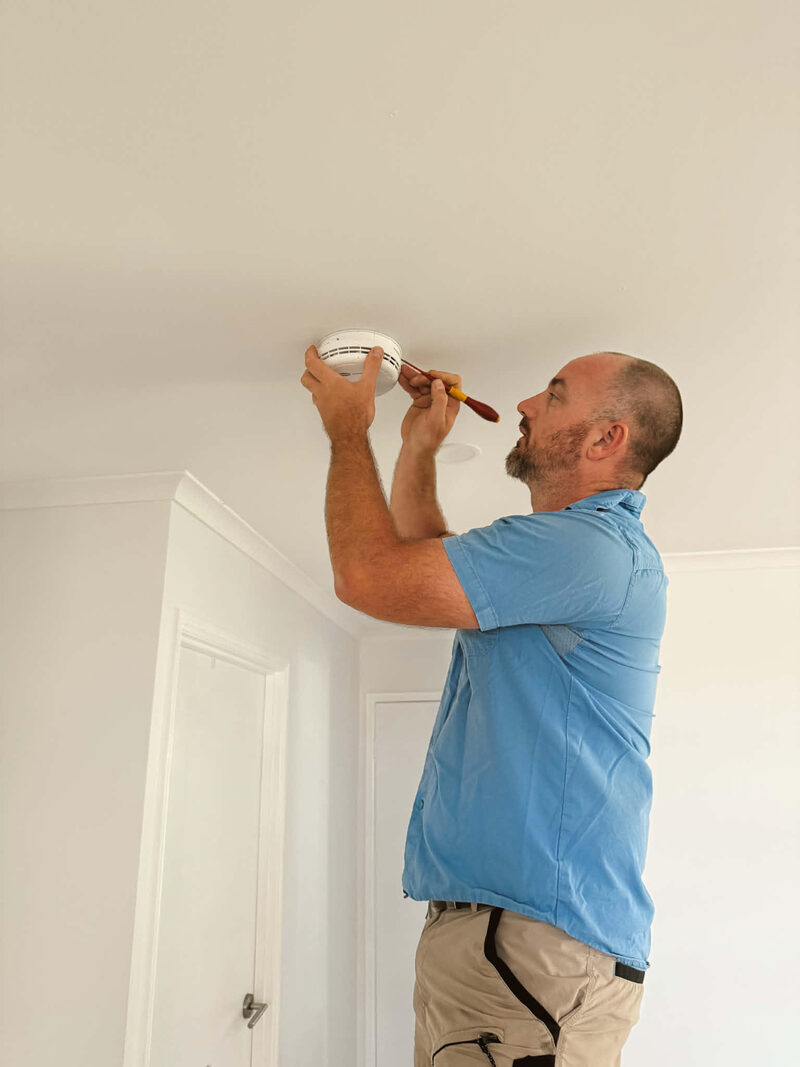
Professional installation by a licensed electrician ensures every alarm is positioned correctly, interconnected properly, and documented for compliance purposes. It also means the homeowner receives a formal compliance certificate that can be used for insurance, property sales, rental agreements and body corporate records. For Brisbane property owners approaching the 2027 deadline, this is the most efficient path from non-compliant to fully covered.
Get Your Property Assessed
Frequently asked questions about QLD smoke alarm legislation
Answers to the questions Brisbane homeowners, landlords and property managers ask most often about Queensland’s smoke alarm laws.
All owner-occupied dwellings in Queensland, including Brisbane, must have fully compliant smoke alarm systems by 1 January 2027. This means photoelectric alarms, interconnected, installed in every bedroom, in hallways connecting bedrooms, and on every level of the home. If your property has not been sold, leased or substantially renovated since 2017, this is the deadline that applies to you.
The maximum penalty for an individual who fails to comply with Queensland smoke alarm legislation is $7,732. Beyond the fine itself, non-compliance can also lead to insurance complications if a fire occurs, civil liability if someone is injured, and enforcement action from Queensland Fire and Emergency Services. The cost of upgrading is a fraction of the potential financial exposure from non-compliance.
Yes. Under current QLD legislation, every bedroom in a domestic dwelling must have its own smoke alarm. This is in addition to alarms in hallways that connect bedrooms to the rest of the home and on every storey. The bedroom requirement is one of the biggest changes from the old rules, which only required hallway alarms. Most Brisbane homes built before 2017 will need additional alarms installed in bedrooms to comply.
Interconnected means that when any single alarm in the dwelling detects smoke and activates, every other alarm in the system sounds simultaneously. This can be achieved through hardwired electrical connection or wireless RF (radio frequency) interconnection. The purpose is to ensure that occupants in any part of the home — particularly those sleeping behind closed doors — are alerted immediately, regardless of where the fire starts.
Battery-operated smoke alarms can technically be mounted by anyone. However, getting the full system right — correct product selection, proper placement in every required location, wireless interconnection programming, and a valid compliance certificate — typically requires professional installation. Hardwired alarms must be installed by a licensed electrician. For most Brisbane homeowners, professional installation is the safest way to ensure the system actually meets every requirement of the legislation.
Ionisation smoke alarms are no longer compliant under Queensland legislation. Even if an ionisation alarm is still functioning, it does not meet the current legal standard. All alarms must be photoelectric type. Ionisation alarms are slower to detect smouldering fires, which are the most common type of fatal house fire in Australia. If your Brisbane home still has ionisation alarms, they need to be replaced with photoelectric units to comply.
A typical single-storey 3-bedroom Brisbane home will need a minimum of four to five alarms: one in each of the three bedrooms, one in the hallway connecting the bedrooms to the rest of the home, and potentially one additional alarm if the living areas are on a separate level or if the floor plan has multiple hallway paths. Two-storey homes will need additional alarms on each level. The exact number depends on the specific floor plan, which is why an on-site assessment is the most reliable way to determine requirements.
Yes. Brisbane rental properties have been required to comply since 1 January 2022. This obligation applies at the point of new lease or lease renewal. If a Brisbane rental property does not currently have photoelectric, interconnected alarms in every bedroom and hallway, the landlord is already in breach of the legislation. Property managers should be confirming compliance status as part of their standard management processes.
Potentially, yes. If a fire occurs in a Brisbane property and the smoke alarm system does not meet current QLD legislation, the insurer may investigate whether the owner met their legal obligations. This can complicate or delay a claim, and in some cases insurers may argue that non-compliance contributed to the extent of the loss. While each policy and claim is different, having a compliant system and a current compliance certificate removes this risk entirely.
Hardwired interconnected alarms are connected through the home’s 240V electrical wiring, with battery backup. Wireless interconnected alarms use RF (radio frequency) signals to communicate between units and run on sealed 10-year lithium batteries. Both methods are fully compliant under QLD law. Wireless is often more practical for existing Brisbane homes because it does not require new cabling through walls and ceilings. Hardwired is common in new builds where the wiring is installed during construction.
While the legislation does not specifically mandate a certificate for owner-occupiers, having one provides documented proof that your property meets the current standard. For landlords and sellers in Brisbane, a compliance certificate is effectively essential — it demonstrates to tenants, buyers, property managers and insurers that the dwelling has been professionally assessed and meets all requirements. It is the simplest way to prove compliance if ever questioned.
No. Smoke alarms powered by replaceable 9-volt batteries are no longer compliant under Queensland legislation. Alarms must be either hardwired to the home’s 240V electrical system with battery backup, or powered by a sealed non-removable 10-year lithium battery. The sealed battery requirement was introduced because removable batteries were frequently taken out by occupants to stop nuisance beeping and never replaced, leaving homes unprotected.
Compliance has been required at the point of sale since 1 January 2022 in Queensland. If a Brisbane property is sold without compliant smoke alarms, the seller may face penalties, and the issue can complicate or delay settlement. Buyers and their solicitors are increasingly checking smoke alarm compliance as part of due diligence. Pre-sale compliance is strongly recommended to avoid last-minute complications and potential legal exposure.
As of the current legislation, there are no extensions planned for the 1 January 2027 deadline for owner-occupied dwellings in Queensland. The phase-in period has already spanned a decade since the original 2017 amendments. Brisbane homeowners should plan on the basis that the deadline is firm and act accordingly. Waiting for a possible extension that may never come is a significant risk given the penalties and safety implications involved.
The legislation behind these requirements
Every requirement on this page traces back to Queensland legislation. Here are the key legal instruments and the government bodies that enforce them.
Fire and Emergency Services Act 1990
This is the primary Queensland legislation governing smoke alarm requirements in domestic dwellings. The Fire and Emergency Services Act 1990 was amended in 2016 to introduce the phased rollout of photoelectric, interconnected smoke alarms across all Queensland homes — the same requirements detailed throughout this page.
Queensland Fire and Emergency Services (QFES)
QFES is the government body responsible for enforcing smoke alarm compliance across Queensland. They conduct inspections, issue directions, and can pursue penalties for non-compliance. Their smoke alarm information page provides the official government perspective on requirements and deadlines.
QLD Government — Smoke Alarm Requirements
The Queensland Government’s official smoke alarm page provides a plain-English summary of the current rules, including the phase-in timeline, who needs to comply, and the types of alarms required. It is the most accessible government resource for Brisbane homeowners trying to understand their obligations.
Australian Standard AS 3786:2014
All compliant smoke alarms in Queensland must meet AS 3786:2014, the Australian standard for smoke alarms. This standard defines the performance, testing, and marking requirements for photoelectric and ionisation smoke alarms. When purchasing alarms, look for the AS 3786:2014 marking on the product to confirm it meets the standard required by QLD law.
All external links open in a new tab and point to official Queensland Government or standards body resources.
Get your Brisbane property compliant before the 2027 deadline
A licensed electrician will assess your home, install compliant photoelectric alarms, interconnect the system, and issue your compliance certificate — usually in a single visit.
We Service 21 Brisbane Suburbs
Click your suburb for local pricing and information.